
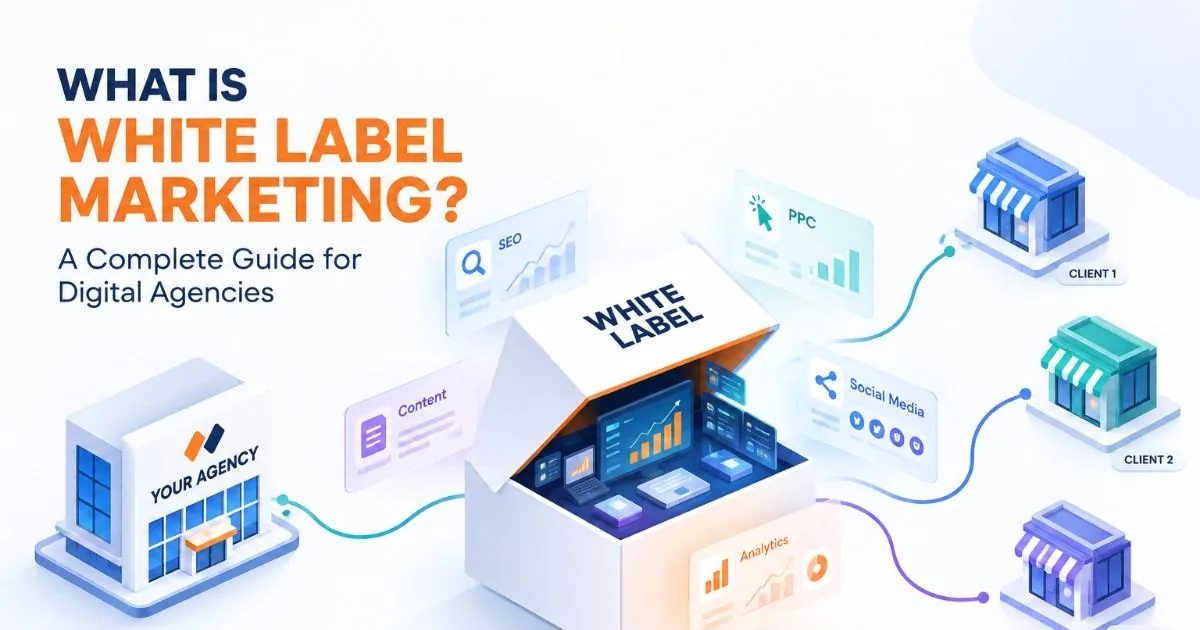
Your clients trust you with their ads, content and SEO. Sooner or later they ask for something else: an app, a booking system, a customer portal, a custom CRM.
Most marketing agencies pass those leads to someone else and lose the account's most valuable work. A white-label engineering partner lets you say yes, keep the relationship and keep the revenue.
This guide shows how to package software work, protect yourself contractually and run delivery without building a dev team.
Why Software Is the Natural Next Service
You already know your clients' goals, funnels and data. You see where the website leaks leads and where manual work eats their week.
That makes you the best-placed person to scope a fix. The build is the only missing piece.
| Client pain you already see | Software you can offer |
|---|---|
| Leads arrive on WhatsApp and get lost | Lead capture app with CRM sync |
| Bookings handled by phone | Online booking and reminders |
| Reports built by hand every month | Automated reporting dashboard |
| Wholesale clients email orders | B2B order portal |
| Customers ask where their order is | Tracking and notification system |
| Staff use spreadsheets for everything | Custom internal tool |
Each of these is a recurring revenue story, not a one-off job.
Productise Before You Pitch
Don't sell "custom development". It sounds open-ended and expensive.
Sell named packages with a fixed scope:
- Lead-to-CRM Kit: forms, scoring, pipeline and email follow-up.
- Booking System: calendar, payments, reminders, admin view.
- Client Portal: login, documents, invoices, support requests.
- Mobile App Starter: one core flow on Android and iOS.
- Automation Pack: connect your tools and remove manual steps.
For each, publish what is included, what is not, and a typical timeline. Then price from a discovery workshop rather than guessing.
Run Discovery Like a Product Studio
Discovery is where you earn your margin. It turns a vague wish into a build plan.
- Interview the client's team about the task, not the tool.
- Map the current flow on one page: who does what, with what data.
- Define one primary outcome, such as "cut order entry from 20 minutes to 3".
- Cut scope to a first release that delivers that outcome.
- Write acceptance criteria a non-technical person can test.
Charge for this stage. It sets expectations and it funds the quote.
A Reference Architecture You Can Reuse
Most small business software follows the same shape. If your partner builds on a standard layout, your quotes get tighter.
- Frontend: Next.js web app, responsive for mobile use.
- API layer: route handlers with schema validation.
- Database: managed Postgres, one schema per product.
- Auth: managed login with role-based access.
- Jobs and webhooks: queue for emails, syncs and reminders.
- Observability: error tracking and uptime alerts.
Below is a secure intake endpoint. It accepts a lead from a client's website, validates it with Zod, verifies an HMAC signature so only your front end can post to it, and forwards it to a CRM. It shows the pattern for any client-facing API.
// app/api/leads/route.ts
import { NextResponse } from "next/server";
import { createHmac, timingSafeEqual } from "node:crypto";
import { z } from "zod";

const LeadSchema = z.object({
  name: z.string().trim().min(2).max(120),
  email: z.string().trim().email().max(200),
  phone: z.string().trim().max(30).optional(),
  message: z.string().trim().max(2000).optional(),
  source: z.string().trim().max(60).default("website"),
});

function isValidSignature(raw: string, signature: string | null): boolean {
  if (!signature) return false;
  const expected = createHmac("sha256", process.env.LEAD_SIGNING_SECRET!)
    .update(raw)
    .digest("hex");
  const a = Buffer.from(expected);
  const b = Buffer.from(signature);
  return a.length === b.length && timingSafeEqual(a, b);
}

export async function POST(req: Request) {
  const raw = await req.text();

  if (!isValidSignature(raw, req.headers.get("x-signature"))) {
    return NextResponse.json({ error: "Invalid signature" }, { status: 401 });
  }

  let json: unknown;
  try {
    json = JSON.parse(raw);
  } catch {
    return NextResponse.json({ error: "Invalid JSON" }, { status: 400 });
  }

  const parsed = LeadSchema.safeParse(json);
  if (!parsed.success) {
    return NextResponse.json(
      { error: "Validation failed", issues: parsed.error.flatten().fieldErrors },
      { status: 422 },
    );
  }

  const res = await fetch(process.env.CRM_WEBHOOK_URL!, {
    method: "POST",
    headers: {
      "content-type": "application/json",
      authorization: `Bearer ${process.env.CRM_API_TOKEN}`,
    },
    body: JSON.stringify(parsed.data),
  });

  if (!res.ok) {
    return NextResponse.json({ error: "CRM unavailable" }, { status: 502 });
  }

  return NextResponse.json({ ok: true }, { status: 201 });
}
Why this matters for you:
- Validation stops bad data before it reaches the client's CRM.
- Signature checks stop bots from flooding the endpoint.
- Timing-safe comparison closes a classic side-channel.
- Clear status codes make debugging fast for both teams.
Install zod first (npm i zod). Add rate limiting at the edge or gateway before it goes live, since it isn't included above.
Keeping the Build Under Your Brand
Your client should deal with one company. That's you.
- The repo lives in your Git organisation
- The client's staging site sits on your subdomain
- Release notes and documentation use your template
- The partner's team uses your Slack channels and Jira project
- No partner logos in code comments, footers or emails
Contract structure that protects you
- Master agreement with the partner: NDA, IP assignment on payment, non-solicit.
- Client agreement with you: scope, milestones, acceptance, support terms.
- Back-to-back terms: deadlines and warranty match on both sides.
Have a lawyer review both. Do not copy a template you found online.
Working Across Timezones
If your clients are in the US or UK and the builders are in India, asynchronous rhythm matters more than overlap.
- A written daily update in Slack, at the same time each day
- Jira tickets with acceptance criteria and a screenshot or recording
- One weekly demo on a recurring calendar slot
- A named backup contact for each timezone
Clear tickets cut the "what did you mean" cycle that eats a day per question.
Pricing and Payments
Quote clients on outcome. Pay your partner on milestones.
| Item | How to handle it |
|---|---|
| Discovery | Paid fixed fee, credited toward build |
| Build | Milestone payments tied to staging demos |
| Hosting and licences | Pass through at cost plus a management fee |
| Support | Monthly retainer with a defined response time |
| Change requests | Hourly or fixed, approved in writing |
For international clients, accept Stripe, PayPal or wire in their currency. Settle with your partner through a multi-currency account to avoid repeated bank fees.
Protecting Your Margin
Margin disappears through scope creep and unclear ownership.
- Write acceptance criteria into every milestone
- Log every request that falls outside scope and price it
- Keep a maintenance retainer, because software needs updates
- Track partner hours against the quote weekly
Track one number above all: gross margin per project, after your own time.
Turning Software Into a Retention Tool
A client with a custom portal or booking app doesn't switch agencies easily. The software becomes part of their daily work.
That's a stronger moat than a monthly ad report. It also opens upsells: analytics, integrations, mobile versions.
Delivering It With INDOTREX
INDOTREX works as the build team behind marketing and digital agencies in the US, UK, Middle East and India. We handle custom software development, business automation and Android and iOS apps, all delivered under your name.
We sign your NDA before discovery, work inside your repos, and hand over documented, tested code. That means fewer surprises, less rework and a codebase you can maintain or extend with us.
If you have a client asking for software, book a free 15-minute engineering strategy call. Bring the request and we'll help you scope it, price it and decide if it fits.