Most startups don't have the budget to build and maintain two separate app teams — one for Android, one for iOS. And yet plenty still end up quoted exactly that, because "native development" is often the default recommendation, regardless of whether it's actually the right fit for an early-stage product.
Flutter changed that calculation. For a large share of startup apps, it lets you ship one codebase to both Android and iOS, cutting development time and cost significantly without the UX compromises cross-platform frameworks used to carry. Here's how the two approaches actually compare, and how to know which one fits your situation.
What "Native" and "Flutter" Actually Mean
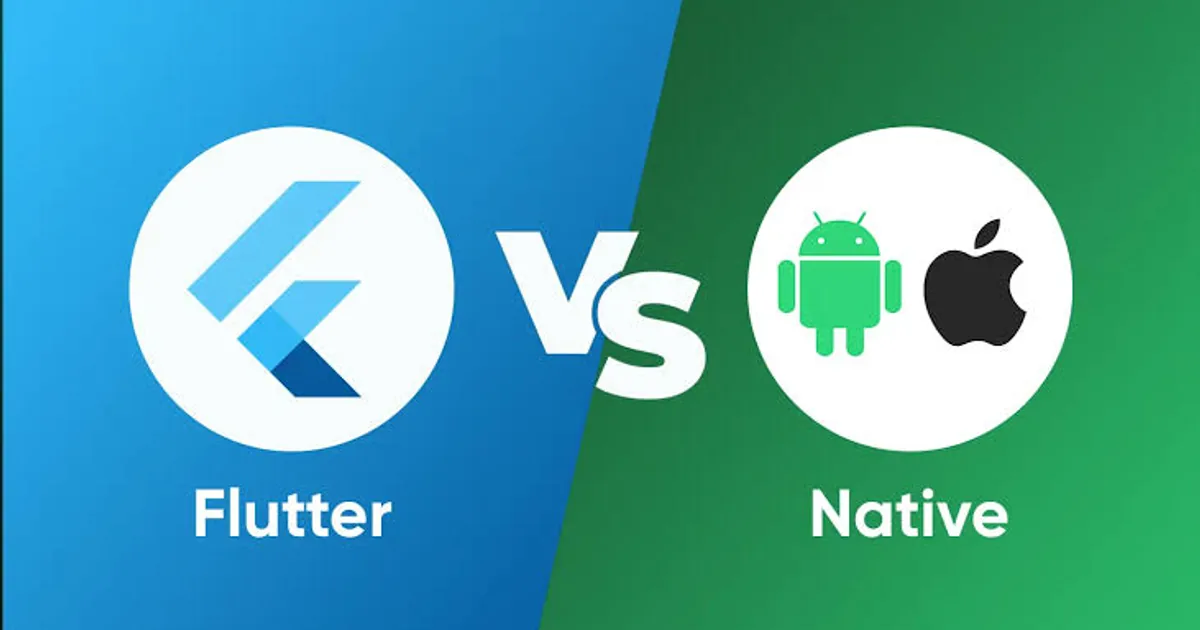
Native development means building two separate apps — one in Kotlin/Java for Android, one in Swift for iOS — each with its own codebase, its own bugs, and its own release cycle.
Flutter (Google's UI toolkit) lets you write one Dart codebase that compiles to native-performance apps on both platforms. It's not a "web view wrapped in an app" the way older cross-platform tools were — Flutter renders its own pixels directly, which is why it can hit near-native performance and a native look and feel.
Cost Comparison
| Native (Android + iOS) | Flutter (Cross-Platform) | |
|---|---|---|
| Codebases to build | 2 | 1 |
| Typical cost for an MVP | ₹8,00,000 – ₹20,00,000+ | ₹5,00,000 – ₹12,00,000 |
| Typical savings | Baseline | 30–40% lower |
| Time to launch both platforms | Sequential or two parallel teams | Simultaneous, single team |
| Ongoing maintenance | Two codebases to update, test, and patch | One codebase for both platforms |
The 30–40% figure isn't marketing — it's a direct consequence of not duplicating development, QA, and bug-fixing work across two separate codebases for the life of the app.
Performance: Is Flutter Actually "Good Enough"?
This used to be a fair concern. It mostly isn't anymore. Flutter compiles to native ARM code and renders through its own high-performance graphics engine (Skia/Impeller), which means:
- Smooth 60fps+ animations and transitions
- Fast app startup times comparable to native apps
- Full access to device hardware (camera, GPS, biometrics, Bluetooth) through plugins
Where native still has a real edge is in extremely performance-intensive apps — heavy AR/VR, advanced camera processing, or apps that need the absolute latest platform-specific API on day one of its release. For the large majority of business apps — eCommerce, booking, delivery, fintech, SaaS dashboards, social — that gap is no longer noticeable to end users.
Time to Market
This is where Flutter's advantage compounds. A single codebase means:
- One feature built once, not implemented twice in two different languages
- One QA cycle, not two
- Simultaneous launch on both app stores instead of staggering iOS after Android (or vice versa) because of resourcing
For a startup racing to validate a product or hit a funding milestone, cutting your build timeline by a third to a half isn't just a cost saving — it's extra runway.
When Native Is Still the Better Call
Flutter isn't the universal answer — a handful of situations genuinely favor native:
- Hardware-intensive apps — advanced camera/AR features, complex Bluetooth device integrations, or apps pushing the limits of device sensors
- Platform-exclusive products — an app built specifically for one platform's ecosystem (e.g., a deeply Apple-Watch-integrated iOS app)
- Enterprises with existing native teams already maintaining large native codebases, where switching stacks isn't worth the migration cost
If none of those describe your project, Flutter is very likely the more cost-efficient and faster path to launch.
What Startups Get Wrong About "Going Native First"
The common reasoning is: "we'll build native because it's more serious/professional." In practice, what actually determines whether an app feels "native" is the quality of the UI implementation and attention to platform conventions — not the underlying framework. A well-built Flutter app, done properly, is indistinguishable from native to the vast majority of users. A poorly built native app is still a poorly built app.
The better question isn't "native or Flutter" in the abstract — it's "does this specific app have a hardware or performance requirement that genuinely needs native?" If the honest answer is no, Flutter gets you to market faster, cheaper, and with one team instead of two.
Build Your App the Cost-Efficient Way
We build both Android and iOS apps — natively when a project genuinely calls for it, and on Flutter when it doesn't, so you're not paying for two codebases you don't need. If you're scoping a new app and want an honest read on which approach fits your product and budget, talk to our team — we'll tell you straight, not just sell you the bigger build.
Also worth reading before you commit: how to choose a reliable mobile app development company in Noida & Gurgaon, and what it actually costs to maintain an app every month after launch.