At some point, almost every growing eCommerce founder asks the same question: should I keep paying Shopify's monthly subscription, or invest once in a fully custom store?
There's no universally "right" answer — it genuinely depends on where your business is and where it's headed. What there is, is a clear set of trade-offs that tend to get glossed over by whichever side an agency happens to specialize in. Since INDOTREX builds both Shopify stores and custom Next.js commerce platforms, here's the comparison as neutrally as we can put it.
The Core Trade-Off, in One Line
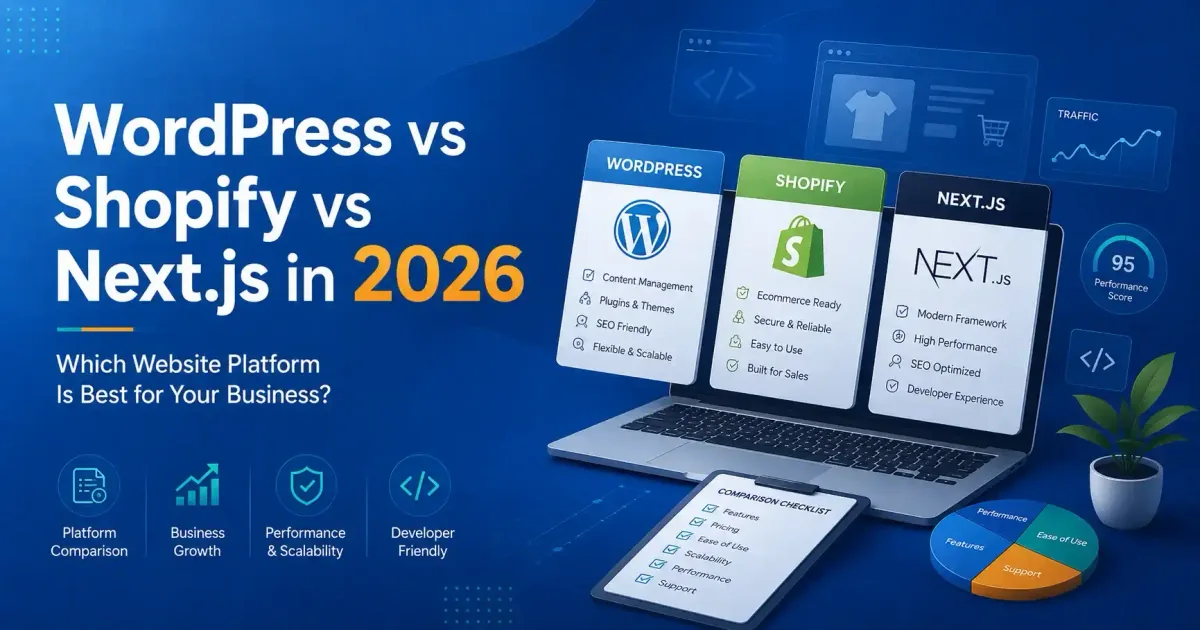
Shopify trades some flexibility and ongoing cost for speed, reliability, and a massive app ecosystem. Custom Next.js commerce trades a higher upfront investment and build time for complete control, top-tier performance, and zero platform lock-in.
Neither is "better" in the abstract. One is better for your specific stage and goals.
Cost Comparison
| Shopify | Custom Next.js Store | |
|---|---|---|
| Upfront cost | Low (store builds from ₹25,000) | Higher (custom build, quoted after scoping) |
| Ongoing cost | Monthly plan + transaction fees + app subscriptions | Hosting + maintenance (often lower long-term) |
| Break-even point | N/A — recurring forever | Typically 18–30 months vs. Shopify Plus-tier costs |
| Hidden costs | Apps for every extra feature add up fast | Custom features built once, owned forever |
If you're testing a new product or market and need to launch fast and cheap, Shopify's low upfront cost wins outright. If you're already doing solid volume and know you're not shutting the brand down in a year, the economics start favoring a custom build.
Performance and Speed
This is where the gap is most visible to customers, even if they can't explain why. Next.js (and headless commerce generally) is built for raw front-end performance — server-side rendering, fine-grained caching, and no theme bloat from stacked apps.
Shopify has improved significantly on performance (Online Store 2.0 is genuinely fast on a clean theme), but every app you install — reviews, upsells, loyalty programs, live chat — adds JavaScript that slows the page down. A custom Next.js store doesn't have that problem because every feature is built in, not bolted on.
For a store doing serious paid-ads volume, a 1-second improvement in load time can measurably move conversion rate — which is often the real financial argument for going custom, not just a technical preference.
Flexibility and Customization
Shopify is deeply customizable within its own rules — themes, Liquid templates, and thousands of apps cover most standard eCommerce needs extremely well. Where it gets limiting is non-standard business logic: complex pricing rules, unusual checkout flows, tight integrations with internal systems, or UI patterns Shopify's theme architecture simply wasn't built for.
A custom Next.js eCommerce build has no such ceiling — if you can describe the feature, it can be built exactly as specified, because there's no platform layer to work around.
Maintenance and Who Needs To Be Involved
Shopify is designed so a non-technical team member can update products, run promotions, and manage orders without touching code — that's a real advantage for lean teams.
A custom store needs a developer (or dev partner) for anything beyond content updates — new features, structural changes, or platform-level work go through your build team rather than an app install. This is a genuine cost, but it also means you're never blocked waiting on a third-party app developer to fix a bug in their code that's breaking your store.
When Shopify Is the Right Call
- You're launching a new product or brand and need to validate demand quickly
- Your catalog and checkout needs are fairly standard
- You don't have (or want) an in-house or retained dev team
- You want your marketing/ops team to manage the store independently day-to-day
When Custom Next.js Commerce Is the Right Call
- You're already doing meaningful volume and app fees/transaction fees are adding up
- You need performance or UX that off-the-shelf themes genuinely can't deliver
- Your business logic — pricing, checkout, integrations — is non-standard
- You want full ownership of your stack with no platform dependency or forced migrations later
A Third Option: Shopify Hydrogen / Headless Shopify
Worth knowing: you don't have to choose "Shopify vs. fully custom" as a binary. Headless Shopify — using Shopify as the backend (inventory, orders, checkout) with a custom Next.js front end — lets you keep Shopify's commerce engine while getting near-fully-custom front-end performance and flexibility. It's a strong middle ground for brands that have outgrown a standard theme but aren't ready to rebuild checkout, payments, and order management from scratch.
Still Not Sure Which Fits Your Business?
We build both — Shopify stores for fast, standard launches, and fully custom eCommerce platforms for businesses that have outgrown what a theme-based store can do. Tell us where your business actually is today, and we'll give you a straight recommendation — not just the option we'd rather sell you. Get in touch to talk it through.
Want the numbers behind the performance claims? See how Next.js commerce can improve your store's speed and sales, and why Next.js is the stronger choice for SEO-friendly websites in general, not just for eCommerce.