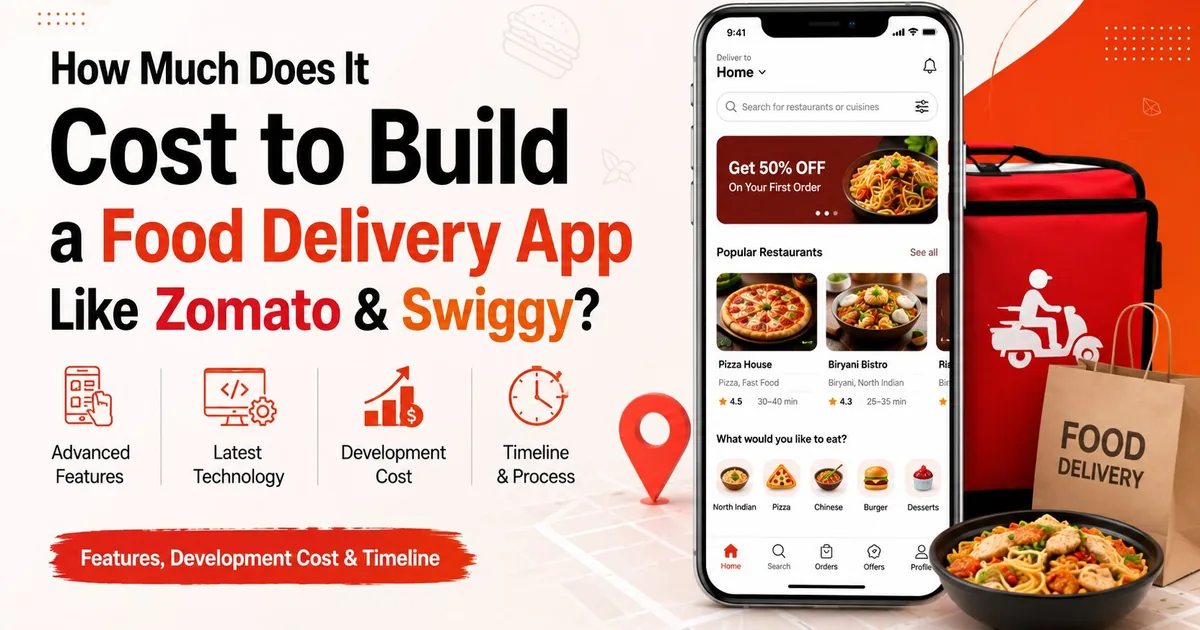
"We want an app like Zomato or Swiggy" is one of the most common requests app developers in India hear. The trouble is that a large food delivery platform is not one app. It is at least four connected products, a real-time logistics system and years of operational work. Building a copy of all of it is rarely the right first step, and the cost estimates you get vary wildly because people mean very different things by "food delivery app".
So let's break it down properly: cost by business model, what each piece costs, the running bills after launch, and what to build first if you're just starting.
First, Which Food Delivery Model Are You Building?
Cost depends far more on your model than on the design.
| Model | Who it suits | What you need |
|---|---|---|
| Single restaurant or cloud kitchen ordering | Restaurants and cloud kitchens tired of aggregator commissions | Ordering app or website, kitchen dashboard, admin |
| Restaurant chain | Brands with several outlets | Ordering app, outlet-wise menus and stock, central admin |
| Multi-restaurant aggregator | Startups building a city-level platform | Customer app, restaurant panel, delivery partner app, admin, dispatch logic |
| Hyperlocal grocery or meal delivery | Tiffin services, grocery stores, meal-prep brands | Ordering, subscriptions, delivery slots, route planning |
A cloud kitchen that wants direct orders does not need a delivery partner app or restaurant onboarding. An aggregator does. That difference alone can move the budget by several lakh rupees.
The Four Parts of a Full Food Delivery Platform
1. Customer app
- Phone OTP login and saved addresses
- Restaurant and dish search with filters (veg, cuisine, rating, delivery time)
- Menu with add-ons and customisation
- Cart, coupons and offers
- UPI, cards, wallets and cash on delivery
- Live order tracking on a map
- Ratings, reviews, reorder and order history
- Push notifications and support chat
2. Restaurant panel
- Accept or reject orders with preparation time
- Menu, price and availability management, including marking items out of stock
- Opening hours and holiday settings
- Sales, payout and commission reports
3. Delivery partner app
- Online/offline status and order requests
- Navigation to the restaurant and customer
- Pickup and delivery confirmation, often with OTP
- Earnings, incentives and payout history
- Background location sharing, handled carefully to save battery
4. Admin panel
- Restaurant and rider onboarding with documents
- Delivery zones, charges and surge rules
- Order monitoring and manual reassignment
- Commission, payout and refund management
- Offers, banners and push campaigns
- Reports by city, restaurant, rider and time of day
Behind all four sits the backend: order flow, rider assignment, real-time location updates, payments and notifications. This is where most of the engineering effort goes.
Food Delivery App Development Cost in India (2026)
These are realistic market ranges for professionally built apps.
| What you build | Typical cost | Timeline |
|---|---|---|
| Online ordering website for one restaurant | From ₹25,000 | 1–3 weeks |
| Single restaurant or cloud kitchen app (Android + iOS, admin, no rider app) | ₹75,000 – ₹2,50,000 | 4–8 weeks |
| Restaurant chain app with outlet management | ₹2,00,000 – ₹4,00,000 | 6–10 weeks |
| Multi-restaurant aggregator (customer, restaurant, rider apps and admin) | ₹4,00,000 – ₹10,00,000 | 3–5 months |
| White-label "clone script", customised | ₹50,000 – ₹1,50,000 | 2–4 weeks |
Apps built with Flutter cover both Android and iOS from one codebase, which keeps costs at the lower end of each range. Our mobile app development cost guide explains platform choices in more detail.
What Drives the Cost Up
- Real-time tracking: live rider location, ETAs and map rendering add significant work and API cost
- Automatic rider assignment: matching orders to the nearest available rider with fairness rules
- Multiple cities and zones: different charges, restaurants and rules per area
- Scheduled orders and subscriptions: common for tiffin and meal-plan businesses
- Loyalty, wallet and referral systems
- Integrations: POS systems, third-party delivery fleets, accounting and WhatsApp
- High traffic: lunch and dinner peaks need a backend that scales
Clone Scripts: Cheap, But Read the Fine Print
Ready-made "Zomato clone" or "Swiggy clone" scripts are sold at low prices, and some can work for a quick pilot. Before buying one, check:
- Do you get the full source code, or only a licence to use compiled apps?
- When was the code last updated, and does it support current Android and iOS versions?
- Will it pass Play Store and App Store review? Apple in particular rejects apps that look like generic templates
- Is it secure? Many scripts have known vulnerabilities or hard-coded keys
- Who fixes bugs after launch, and how fast?
A clone script that cannot be maintained becomes expensive very quickly.
Running Costs After Launch
The build is only part of the budget. A food delivery platform also pays every month for:
| Item | How it's charged |
|---|---|
| Cloud servers and database | Monthly, grows with orders |
| Maps, routing and location APIs | Per request, can be significant at scale |
| SMS OTP and notifications | Per message |
| Payment gateway | A percentage of each transaction |
| Apple developer account | About ₹8,000 a year |
| Maintenance and updates | Commonly 15–20% of build cost per year |
| Customer support | Staff or tools |
Maps and SMS costs are often missed in early budgets. Design the app to minimise unnecessary location calls and OTP retries. See our guide to mobile app maintenance costs for typical monthly ranges.
Build Your Own App or List on Aggregators?
For restaurants, this is not either-or. Aggregators bring discovery and new customers, but charge a sizeable commission on every order and keep the customer relationship. Your own app or ordering website works best for repeat customers who already know you.
A common approach:
- Stay on aggregators for new customer discovery
- Use packaging inserts, QR codes and WhatsApp to bring repeat customers to your own ordering channel
- Reward direct orders with a small loyalty benefit
India's Open Network for Digital Commerce (ONDC) is another channel some restaurants use to reach customers through multiple buyer apps. It is worth evaluating alongside your own app.
A Sensible Way to Start
- Validate demand cheaply. A restaurant can start with an ordering website and WhatsApp before investing in apps.
- Launch one area first. For aggregators, a single neighbourhood or a few sectors with enough restaurants to give choice.
- Use third-party delivery at first. Hyperlocal delivery services can handle riders until order volumes justify your own fleet and rider app.
- Add features based on data. Loyalty, scheduling and recommendations come once you know your customers.
Example: A Cloud Kitchen Brand in Gurgaon
Say a cloud kitchen brand in Gurgaon with three outlets wants direct orders to reduce aggregator dependence. A practical first build is a Flutter customer app and ordering website with outlet-wise menus, UPI and COD, a kitchen dashboard to accept orders, and integration with a third-party delivery service instead of its own riders. That lands in the ₹1.5 lakh to ₹3 lakh range. A rider app and loyalty wallet can be added later if direct orders grow.
Why Talk to INDOTREX
INDOTREX builds ordering apps, delivery platforms and admin systems for restaurants, cloud kitchens and startups across India from our New Delhi team. We help you choose the smallest version that tests your idea, give you an itemised estimate for each app and panel, and make sure you own the code and store accounts.
Get a free estimate within two business days. Tell us your model (single restaurant, chain or aggregator), your city and the features you need first.
- Chat with us on WhatsApp
- Request a free quotation
- See Android app development and iOS app development
Frequently Asked Questions
How much does it cost to build a food delivery app in India?
A single restaurant or cloud kitchen app typically costs ₹75,000 to ₹2.5 lakh. A full multi-restaurant platform with customer, restaurant and rider apps plus an admin panel costs ₹4 lakh to ₹10 lakh.
How much does an app like Zomato or Swiggy cost?
A basic aggregator with the same core flows costs ₹4 lakh to ₹10 lakh. Matching the scale and features of large platforms takes years of ongoing development, so start with a focused version.
How long does it take to build a food delivery app?
A single restaurant ordering app takes about four to eight weeks. A full aggregator platform typically takes three to five months.
Is a clone script a good idea?
It can work for a quick pilot, but check source code ownership, update history, security and app store approval before buying.
What are the monthly costs of running a food delivery app?
Servers, maps and location APIs, SMS, payment gateway fees, app store fees, maintenance and support. Maps and SMS costs grow with order volume.
Should a restaurant build its own app?
If you have regular repeat customers, your own app or ordering website reduces commissions on those orders. Most restaurants keep using aggregators for new customers as well.